


Sciatic Nerve Pain 101: Why It Hurts and How to Help

Updated: Jul 25, 2025
Sciatic nerve pain... what a pain in the butt (literally)!
Sciatic nerve pain is sometimes accompanied by radiating numbness or tingling down one or both legs that feels like pins and needles. It can also include pain in your butt, hips, or back.
So what exactly is it and what can you do?

The sciatic nerve is the largest nerve in your body. It arises from the sacral plexus which is a group of nerves that provide motor and sensory innervation to the lower limbs, pelvis, and perineum (the pelvic floor area).
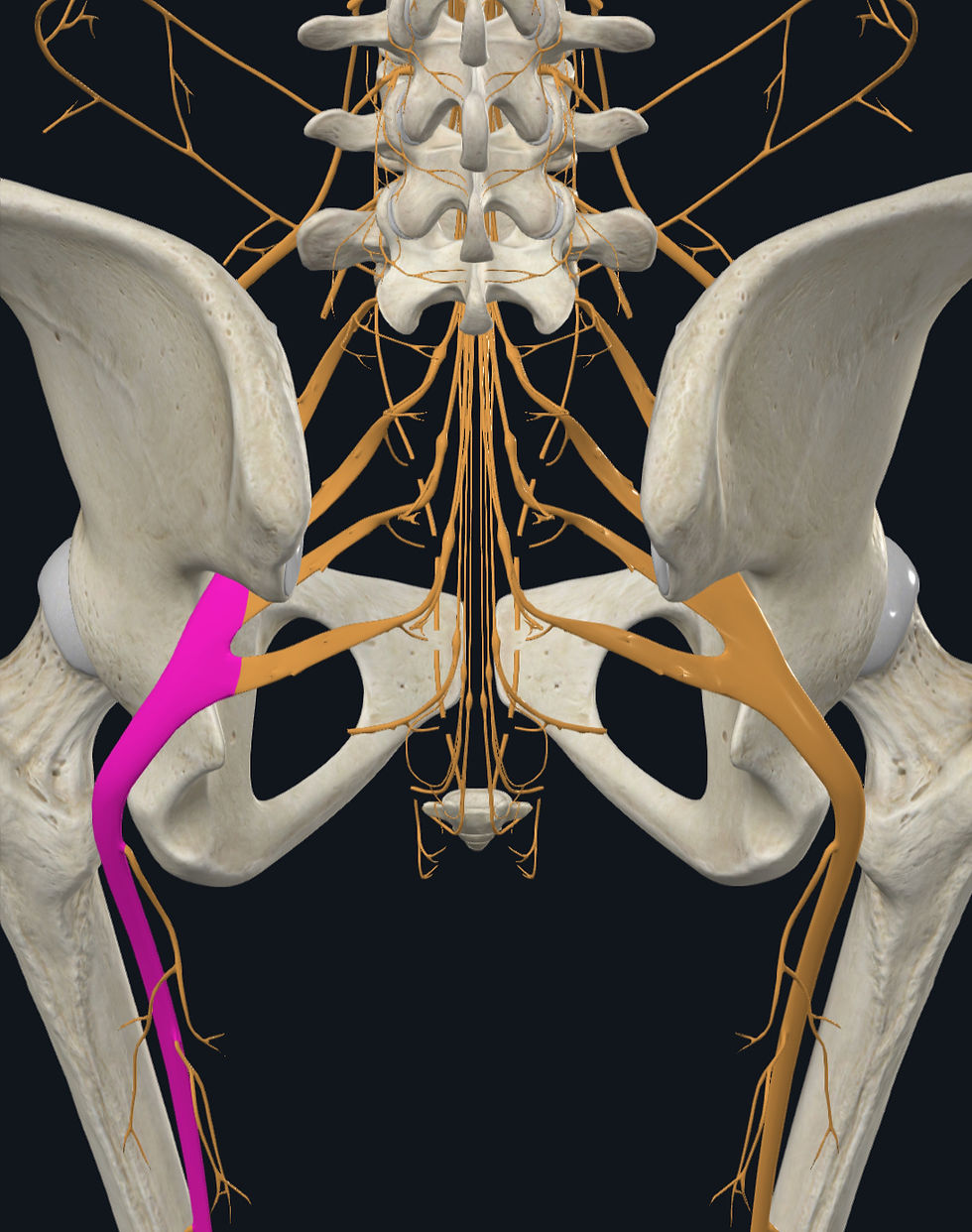
From the sacral plexus, the sciatic nerve runs down the posterior wall of the pelvis and hip (where your glute muscles and deep hip rotators live) passing through the piriformis muscle and the obturator internus muscle. Both of these muscles are hip external rotators and can be culprits of sciatic nerve pain. This area of the posterior hip is a common area of discomfort and an area to address when problem solving sciatic pain (don't worry we will get to it in a bit).

From the pelvis and hip the sciatic nerve continues down the back of the thigh weaving through and supplying innervation to the hamstring muscles. It splits just above the back of the knee into the tibial nerve and the common fibular nerve (also known as peroneal nerve). The tibial nerve then continues down the back of the lower leg to divide into the medial calcaneal nerve, the sural nerve, and the lateral and medial plantar nerves, serving the muscles of the posterior compartment of the leg and the sole of the foot.

The common fibular nerve branches out to become the superficial and deep fibular nerves which supply the muscles of the lateral and anterior compartment of the lower leg and foot.
This is why tingling in the lower leg and down in the foot and toes is a common symptom of sciatic nerve issues/pain.


As you can see, the sciatic nerve has a long, winding, and weaving path, journeying through many different muscles and structures from the pelvis through the legs and into the foot.
Quick & Important Note:

There are many reasons why you might get sciatica (sciatic nerve pain) including spine/disc related conditions. It is important watch out for any red flags that warrant immediate medical attention including:
Loss of bowel and bladder control
Numbness in the groin, inner thighs, or buttock region
Severe leg weakness/paralysis/loss of motor function
Rapid worsening of weakness, numbness, and/or changes in reflexes
History of trauma/risk of fractures
History of cancer
Signs of fever or infection
Persistent pain unrelieved by rest, esp. if accompanied by constitutional signs & symptoms
If you are not experiencing any red flags, there are a few movement tools you can use to help restore mobility of the tissues surrounding the sciatic nerve and improve how you are moving for symptomatic relief.

Range of motion in the articulation of the bones that make up the pelvis, hip joint, leg, and foot, and the mobility and strength of the muscles surrounding these areas contributes to how the sciatic nerve is gliding between the tissues of the lower extremity.
A pelvis, hip, leg, and foot that moves well gives room for the sciatic nerve to slide and glide through all the tissues it weaves through.
If you have been prescribed or have been trying on your own exercises like bridges, clamshells, and figure 4 stretches for your sciatic nerve pain and are not getting any relief, it is time to dig a little deeper and step outside the box of cookie cutter movement fixes.
These 6 things are excellent movement tools to help you create more mobility and strength in the pelvis, hip, leg, and foot and alleviate symptoms of sciatic nerve pain.
As always, consult a medical professional and get assessed by a licensed Physical Therapist to ensure individualized care & treatment. This blog is merely meant to give you ideas and a starting point to get going and find some relief.
Perform the exercises on both sides and notice any differences between your sides!
Release gripping around the back of the hip with ball release work: Ball release work is great for increased flexibility, proprioception, sensory feedback, and enhanced force production ability in the muscles you are rolling out (in this case, the pelvic floor and posterior hip).
Start seated in a chair and fit the ball just to the inside of your sit bone. Breathe, and play with some leg movement and pelvic tilts. Stay here for 1-2 min.
Next, go onto your back with the ball under one side of the back of the hip in your glute region, and explore leg and pelvic movement in different spots. Stay here for 2-3 min.
Next, it is important to follow up release work with movement! This is how you actually make change in how you move and feel long term.
Perform a nerve glide: Nerve flossing is one gentle way to mobilize the sciatic nerve and potentially relieve symptoms that travel down the leg into the foot.
This video is sped up. Move slowly!
Start with a relaxed foot and extend the leg up as much as you can. Dorsiflex foot at the top for a moment, pulling the top of the foot and toes down toward you. Now relax the foot as you re-bend the knee toward your chest and bring the leg down. Perform 10 repetitions.
Add a fibular (peroneal) nerve floss to it: With a relaxed foot, extend the leg up as much as you can. Invert the foot at the top for a moment (outer ankle up, sole of the foot pointing in). Now relax the foot and bend the knee bringing the leg back down. Perform 10 repetitions.
Try a posterior hip stretch and a hip rotator stretch: Instead of the figure 4 stretch, try these two stretches:
Now that we have opened up more space in the hip, let's get the pelvis moving.
Perform pelvic mobility exercises: When the bones of the pelvis and hip move well, the muscles which move the bones function better.
As you are practicing these moves, notice if any of the movements feel sticky, are hard to access, or are particularly sensational (lots of stretch and sensation going on when performing them).
Try 5-10 repetitions of each movement.
Learn how to supinate your foot: Your foot is intimately connected to your hip and pelvis and influences how the hip functions.
When a joint isn’t moving well, the surrounding tissues will adjust and compensate to make up the difference.
The feet are our foundation and with 33 joints in each foot, ensuring they can move well and open and close at the appropriate times during the gait cycle will feed up the chain into how the bones of the legs, pelvis, and spine are moving.
In the exercise above we are practicing how to supinate the foot by turning the pelvis over the femur. This is one shape the leg makes during the gait cycle and is a great way to unwind tension from the hip down the leg.
This exercise puts the femur into a relative internal rotation and helps to open and lengthen the external rotators of the hip, two of which (the piriformis and obturator internus) sandwich the sciatic nerve.
Try 8 reps for 2 sets.
Strengthen the entire kinetic chain: Strong glutes, hips and legs = better lower extremity function.
These 3 are my favorite because they incorporate range of motion, mobility, strength, stability, and power, hitting all the high notes to help you maximize your glute and hip muscle development with connection to your foot.
Try these as a circuit for 3-5 rounds:
Foam roller hip rotations: 10-20x each side
Front foot elevated lunge: 8-10x each side (start with bodyweight, then add external weight as you progress)
Step up to knee drive: 5-8x each side (lower the box/step height then increase it as you progress)
In summary, sciatic nerve issues are complex.
This blog tackles just a few movement pieces that are important and wonderful tools and strategies for your movement tool box to help you problem solve when dealing with sciatic pain and get you moving better! Make sure to save this post and subscribe to my YouTube channel and follow me on Instagram for more.


Comments